
Feature distribution statistics as a loss objective for robust white balance correction
F. Kınlı, F. Kıraç
Machine Vision and Applications
Abstract
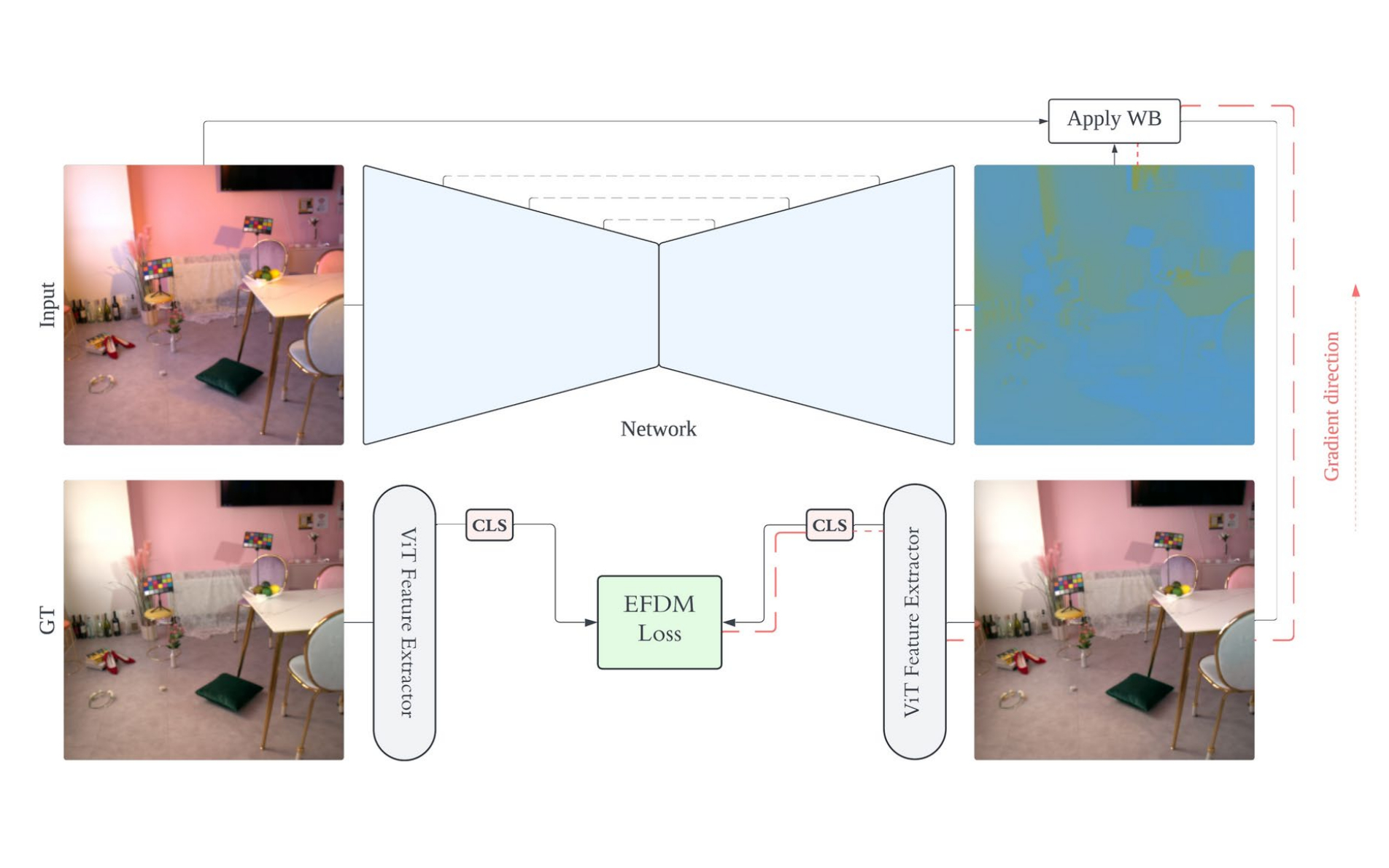
White balance (WB) correction is critical for accurate color reproduction in digital images, especially under complex, multi-illuminant lighting conditions. Traditional methods, such as the Gray-World assumption, rely on global statistics and struggle in real-world, non-uniform lighting scenarios. Modern deep learning approaches, including convolutional and attention-based architectures, have significantly advanced WB correction but often fail to explicitly account for higher-order feature distribution statistics, which may limit their robustness in challenging environments. This study introduces a novel framework that leverages Exact Feature Distribution Matching (EFDM) as a loss objective to align feature distributions across multiple moments, including mean, variance, skewness, and kurtosis. By modeling lighting as a style factor, the method explicitly addresses distributional shifts caused by complex illumination, offering a robust solution for WB correction. The framework integrates EFDM with a Vision Transformer architecture, enabling precise handling of global and local lighting variations. Extensive experiments on the large-scale multi-illuminant (LSMI) dataset demonstrate the superiority of the proposed approach over state-of-the-art methods and commonly used loss functions when applied to the same architecture. Qualitative and quantitative evaluations highlight its effectiveness in achieving perceptually accurate WB correction, particularly in multi-illuminant environments. By bridging statistical modeling with modern deep learning, this work establishes the critical role of feature distribution alignment in advancing WB correction and sets a new benchmark for robustness and generalization in complex lighting scenarios.
Bibtex:
@article{kinli2025feature,
  title={Feature distribution statistics as a loss objective for robust white balance correction},
  author={K{\i}nl{\i}, Furkan and K{\i}ra{\c{c}}, Furkan},
  journal={Machine Vision and Applications},
  volume={36},
  number={3},
  pages={1--20},
  year={2025},
  publisher={Springer}
}